Here’s a more in-depth, authority-style blog—expanded with deeper insights, real-world context, and stronger positioning so it feels like it’s coming from someone who actually deals with these situations daily:
The Biggest (and Most Expensive) Mistakes People Make When Buying a Car
Buying a car is one of the largest financial decisions most people make—yet it’s often treated like a routine purchase.
Walk into a dealership or meet a private seller, take a quick test drive, sign a few documents, and it’s done.
But behind that simple process are financial traps, legal risks, and costly oversights that can follow you for years.
If you’ve ever felt unsure during a car purchase, you’re not alone. The system is not always designed to make things clear—it’s designed to close deals.
And that’s exactly why so many buyers end up overpaying, under-protected, or stuck with problems they didn’t see coming.
Let’s break down the most common mistakes—and more importantly, how to avoid them.
1. Focusing Only on the Monthly Payment Instead of the Total Cost
This is, without question, the most common mistake.
Most buyers walk in with one number in mind:
“I just need to keep my payment under $X per month.”
On the surface, that seems reasonable. But this mindset shifts your focus away from the real cost of the vehicle.
Here’s what often happens behind the scenes:
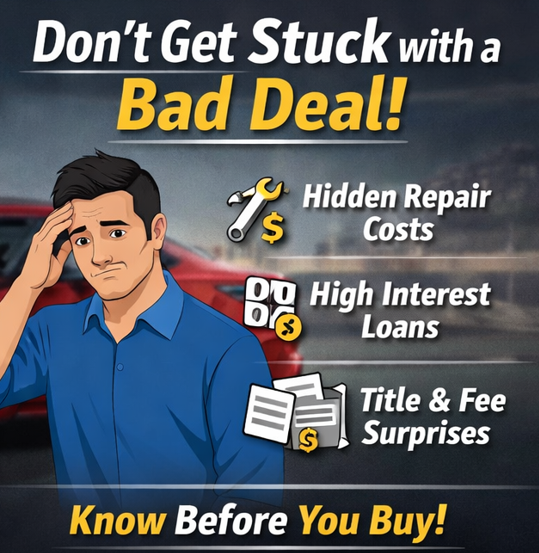
- The loan term gets extended (60 → 72 → even 84 months)
- Interest rates quietly increase
- Add-ons get rolled into the loan
- The total price becomes inflated
You leave feeling comfortable with the payment—but you may have just committed to paying thousands more than necessary.
Example:
A $20,000 car can easily turn into a $28,000+ total cost over time with interest and extended terms.
What to do instead:
- Always ask for the total out-the-door price
- Review the full loan breakdown, not just the payment
- Compare financing options before committing
2. Assuming a Clean Car Means a Clean History
A car can look flawless—and still have a problematic past.
Many buyers rely on appearance and a smooth test drive as proof that the vehicle is “good.”
But some of the most serious issues are invisible:
- Prior accidents that were poorly repaired
- Salvage or rebuilt titles
- Flood damage
- Odometer discrepancies
These issues don’t just affect value—they can affect safety, insurability, and resale.
And once you’ve purchased the car, they become your problem.
What to do instead:
- Always pull a vehicle history report
- Verify the VIN across multiple sources if possible
- Be cautious of deals that seem “too good” compared to market value
3. Skipping a Pre-Purchase Inspection
A test drive tells you how a car feels—not what’s wrong with it.
Even experienced drivers can miss:
- Engine or transmission issues
- Frame damage
- Hidden leaks
- Electrical problems
A professional inspection, on the other hand, is designed to catch exactly those things.
Skipping it is often a decision made to save time or money—but it can lead to repairs costing thousands shortly after purchase.
What to do instead:
- Hire a trusted mechanic for a pre-purchase inspection
- If a seller refuses an inspection, consider that a red flag
- Treat the inspection as non-negotiable, not optional
4. Overlooking Registration, Taxes, and Compliance Costs
Many buyers calculate their budget based on the purchase price alone.
But the true cost of buying a car includes several additional layers:
- Sales tax
- Title transfer fees
- Registration fees
- Smog and emissions compliance
- Potential penalties or back fees
In places like California, these costs can be significant—and in some cases, complicated depending on the vehicle’s history.
What seems like a “great deal” can quickly become expensive once these are factored in.
What to do instead:
- Ask for a full cost breakdown before buying
- Verify the vehicle’s registration status
- Confirm whether any fees or penalties are outstanding
5. Letting Emotions Drive the Decision
Cars are emotional purchases.
You see something clean, powerful, or rare—and suddenly, it’s not just transportation anymore.
It’s excitement. Status. Identity.
That emotional connection is exactly what weakens your position as a buyer.
When emotions take over:
- Red flags get ignored
- Negotiation becomes harder
- Bad terms feel easier to accept
Sellers and dealerships recognize this immediately—and it shifts the advantage away from you.
What to do instead:
- Set your criteria before you start shopping
- Be willing to walk away, no matter how much you like the car
- Treat the purchase as a business decision, not an emotional one
6. Not Understanding the Paperwork You’re Signing
This is where many costly surprises happen.
Buyers often sign contracts quickly, trusting that everything is standard.
But buried in the paperwork can be:
- Add-ons you didn’t clearly agree to
- Warranty terms that don’t benefit you
- Financing conditions that increase long-term cost
Once signed, these agreements are legally binding.
What to do instead:
- Take your time reviewing every document
- Ask questions about anything unclear
- Never feel pressured to sign on the spot
7. Not Asking for Help When It Matters
Many people try to handle the entire process alone—even when they’re unsure.
Whether it’s:
- Verifying paperwork
- Understanding registration requirements
- Calculating true costs
Getting guidance from someone experienced can make a significant difference.
A small question at the right time can prevent a major mistake.
Final Thoughts: It’s Usually Not the Car—It’s the Deal
Most people don’t end up with a bad vehicle.
They end up with:
- A bad loan
- Unexpected costs
- Hidden issues
- Or a deal that didn’t fully make sense
The difference between a smart purchase and a costly mistake often comes down to awareness and preparation.
Take your time. Verify everything. Contact us .
Because once the deal is done, the responsibility is yours.
Have You Experienced This?
If you’ve ever bought a car, there’s a good chance you’ve run into at least one of these situations.
What’s a mistake you’ve made—or seen someone else make—during the process?
Sharing it might help someone else avoid it.